Latest Posts

Review: Chef Yu’s Reinvention with Theodore Rex (Houston, TX)

On my recent trip to Houston, I discovered Theodore Rex, a 28-seat restaurant from Chef Yu situated in the same space as his acclaimed and now closed Oxtail. Chef Yu is a James Beard award winner and rose to culinary fame with his vegetable tasting menu. After losing passion for the tasting menu concept over the last 5 years, he decided to open a “new” restaurant with a shareable plate concept. Theodore Rex was so new that I had not heard of it until Chef Takata at Kata Robata recommended the restaurant for my last dinner in Houston. The restaurant opened on Friday, October 6. As expected, reservations were already booked out for October. I called the restaurant and was able to get a walk-in seat. The restaurant reserves four bar seats facing the kitchen and one table for walk-ins. Did Chef Yu’s reinvention live up to the hype?

My Uber driver had trouble finding the restaurant in the sketchy looking warehouse district as it has been badly affected by the recent flooding. Once I entered the small and inviting space, I was captivated by the mismatched décor that alternated between rustic, industrial and modern…but it all blended together seamlessly. I was presented with a short menu and selected a few recommended dishes. In addition, the restaurant also has a good selection of wine and cocktails at affordable prices.

  1. Tomato Toast – Rye and flaxseed pan de miel toasted and dressed with tomato fondant, green tomatoes, water, fresh grape, tomato slices and fresh herbs. This dish was a classic holdover from Oxtail and was a perfect start to my dinner. The toast was surprisingly light and had both tartness and sweetness from the tomatoes and grapes. There was an underlying hint of spice that added another dimension to the dish.
  1. Potato Pave – Thinly sliced Yukon Gold potatoes layered with butter and cream, baked and then pan seared in chicken drippings. The chef then added sofrito and celery, shallot, carrot and parmigiana reggiano. The potatoes were crispy on the outside and soft and buttery on the inside. The only negative was that the combination of the sauce and parmigiana reggiano made the dish too salty. I asked my friend to try it and he agreed… this coming from a guy who likes salty food.
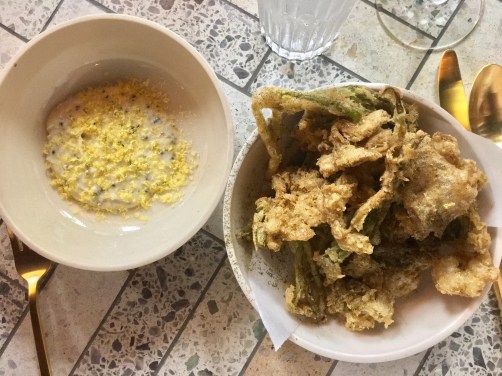
  1. Pankora-battered Indian Creek “Oyster” Mushrooms” – This tempura dish was made with brown rice and chickpea pankora batter, Indian creek oyster mushrooms and bunching onions. These fried mushrooms were served with a white onion soubise and hackleback roe sauce and topped with cured egg yolk. I had such high expectation after the waiter described this dish to me eloquently. However, all I tasted was the batter and more fat from the sauce. The oyster mushrooms and all the other fancy ingredients got lost in the preparation process. This dish could benefit from some tartness to offset the grease. The batter was well prepared; however, it just lacked any personality. This was a reversal of my Texas bias of “go big or go home.”
img_1646

  1. “Guinea” Hen – My main entrée was a chicken dish: the horror! I rarely order chicken, but the waiter sold me on this. The chef brined a breast of a French guinea hen and then pan seared it. The breast was sliced and added to a broth of fermented green garbie and chicken. The meat was then topped with a salad of sliced onion, cucumber and herbs. The green garbie were fermented for one and half weeks creating a stronger onion taste that stood up to the chicken broth. On my first bite of the brined chicken, I did not know what to make of the texture. My best description would have to be “bouncy”. After a few more bites, I started to like it. The chicken breast had a soft and chewy texture at the same time and worked with the soupy sauce. I generally do not like onion, but it added a lot of extra flavor to this dish without overwhelming the delicate chicken. This dish perfectly described the style that Theodore Rex is trying to capture in its menu, experimental and yet approachable.
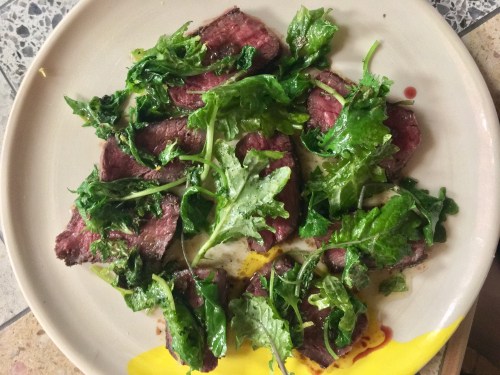
  1. Roasted Texas Waygu – This dish highlighted a “Denver cut” that was perfectly seasoned with salt and pepper and then seared and basted with butter. The steak rested atop a sherry vinegar pan sauce and topped with fermented radish caramelized in beef fat and cooked down in beef stock. Charcoal wilted mizuna and kale finished the dish. This was my friend’s favorite dish of his meal and he could not stop raving about it. I had a taste and had to agree that this was a highlight of the night. The steak melted in my mouth and the sauce and vegetable accompaniments lightened an otherwise heavy protein. This was another standout entrée for all meat lovers. It may have been the best steak I’ve had in Houston so far.
img_1615

  1. “Saijo” Persimmons – This was a simple yet complex and delicious dessert. Very ripe “Saijo” Persimmons were skinned and finished with fresh calamansi juice, olive oil and finishing salt. The salt enhanced the sweetness of the persimmons and kept them from going into the candy land territory. I finished this dish in less than a minute, which should tell you how much I liked this dessert.
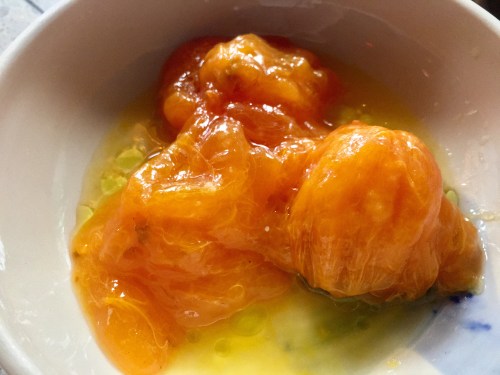
img_1696

While I had my meal, Chef Yu came by on a few occasions to chat about the food and his background. I asked him why he closed down his acclaimed tasting menu restaurant for this new endeavor. His response was that he wanted to focus on simplicity and the ingredients at the core of his menu. Furthermore, he wanted to be passionate about his food again. I also found out that his favorite vegetable was carrot and he hopes that it will be an addition to the current roster. The menu at Theodore Rex changes every week and is very affordable for the quality, effort and creativity.

img_1688

My experience at Theodore Rex was overall very positive. As the restaurant just opened a few days before my dining experience, some kinks still need to be worked out. There are more hits than misses with the experimental menu and that should continue to improve as the chef du cuisine, Jason White, gets his bearings. Theodore Rex should be on your list to try before it becomes impossible to secure a reservation. This restaurant is a breath of fresh air for Houston’s crowded dining scene.

For related articles, visit the TRAVEL page or the World Travel Index.

Author: Chau Hoang

Featured photo courtesy of houstonfoodfinder.com

Review: The “Beginner’s Omakase” – Sushi by Bou at Sanctuary Hotel (NYC)

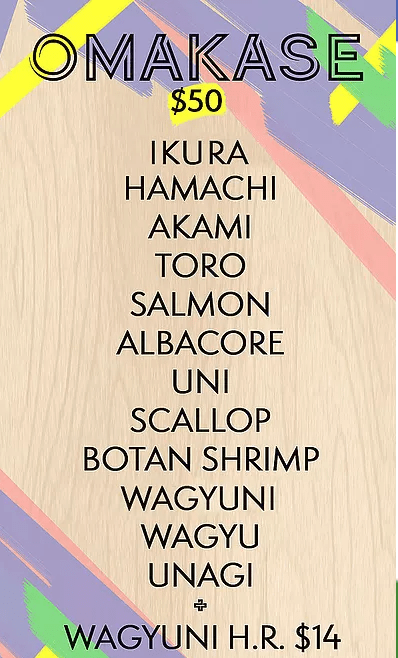
The concept of affordable omakase that is meant to be eaten within 30 minutes is relatively new to New York City. Sushi on Jones by Chef David Bouhadana launched this trend in 2016 with its first outdoor sushi stall. Fast forward a year and Chef Bouhadana has moved on to open Sushi by Bou at the Gansevoort Market with the same concept, $50 omakase comprising of 12 pieces of nigiri. By July 2017, Chef Bouhadana opened a second Sushi by Bou location at the Sanctuary Hotel. I was intrigued by this speed eating concept so I reserved dinner for two one Monday evening. How did this omakase compare to the typical sushi experience?

Sushi by Bou menu

First, we needed to find the entrance. The restaurant is in the basement level to the left of the Sanctuary Hotel’s main entrance. A bright neon sign and a lot of graffiti indicated that we were at the general vicinity where we could search for a semi-hidden door. Once we passed through the grungy looking entrance, we were greeted with a trendy studio-sized restaurant containing a sushi counter and a “bar”. I had hoped that we would be served by Chef Bouhadana, but we ended up with his sous chef. Once we settled into our seats at the counter, we ordered two cocktails, one sake-based and one whisky-based. My sake cocktail was awful while my cousin’s whisky cocktail was surprisingly easy to drink. This inconsistency was the theme for the rest of the meal.

The sous chef started the timer indicating the beginning of our omakase and then proceeded to feed us one nigiri after another. At times, I felt like I was in a sushi eating contest within a NY minute…which I had expected. Some pieces were nicely composed while other nigiri were just average. The quality of the fish is better than your neighborhood sushi joint in the city and tended to be kissed by a blowtorch. Even though the rice seasoning was nicely balanced between vinegar, sugar and salt, the overall quality was just above average. The omakase veered toward traditional sushi with the exception of one nigiri combination of waygu beef and uni. This Frankenstein nigiri hinted at what Chef Boudahana’s creativity can bring given the right conditions. This piece was my favorite nigiri of the night.

After ingesting 12 pieces of sushi in 30 minutes, we were asked if we wanted to order additional nigiri and I declined. For the price and quality, I did not think it warranted ordering extra pieces. My cousin, who is an omakase novice, loved it for both the trendy atmosphere and generally above average quality for the price. He summed up this experience best as a “beginner’s omakase” and I would have to agree. Sushi by Bou’s $50 chef tasting is an enticing entry point in a sea of $100+ options in Manhattan.

For related articles, visit the TRAVEL page or the World Travel Index.

Author: Chau Hoang

Feature photo courtesy of Sushi by Bou

Vietnamese Grilled Chili Bread / Bánh Mì Nướng Muối Ớt

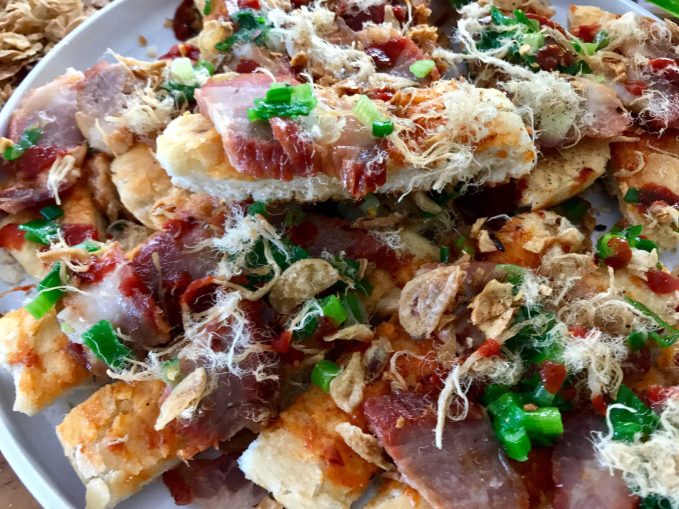
Vietnamese street food has been gaining popularity over the past few years. The combination of influences from western foodie culture and flavors from its Asian neighbors created an interesting variety of new offerings. Vietnamese grilled chili bread or bánh mì nướng muối ớt is a fusion dish that is made for gatherings. This snack is highly customizable and elevates a few inexpensive ingredients to the next level. This is our version of this popular street snack.

Ingredients:

2 loaves of bread such as Portuguese roll or similar type of bread that has a  nice crust with a light and soft inside.

1 tablespoon of chili paste such as Sambal Oelek Chili Paste

1 tablespoon of Sriracha (and more to garnish at the end)

1 tablespoon of regular mayonnaise or Kewpie mayonnaise

1 tablespoon of butter

2 stalks of scallion

2 tablespoons of vegetable oil

1/2 teaspoon of sugar

1 tablespoon of garlic (approximately 3 cloves)

Handful of fried shallots

Sprinkle of ground black pepper

Meat Toppings:

1/4 pound of Chinese BBQ pork or any other meat toppings like sausage or ham.

1 cup of pork floss

Any meat toppings that are in your fridge should work.

Directions:

Mix 1 tablespoon of chili paste, 1 tablespoon of sriracha, 1 tablespoon of mayonnaise and 1/2 teaspoon of sugar.

Diced 2 stalks of scallion. Mix scallion with 1 tablespoon of vegetable oil and microwave for 30 seconds. You can also make scallion oil in a pan.

Minced 3 cloves of garlic (approximately 1 tablespoon). Heat a pan on medium heat with 1 tablespoon of vegetable oil and add garlic. Remove from the stove when garlic turns golden brown.

Thinly slice BBQ pork and butter.

Toast the bread for 3-4 minutes in a toaster oven until the top is slightly crunchy and the insides are soft. This will make it easier to flatten the bread.  Carefully remove the loaves of bread from the toaster. Using a rolling pin, flatten each loaf.

You can continue to use the toaster oven for the next step or place a baking rack over the burners on the stove. I prefer the stove so I can easily control the next steps. Heat the stove on low. Spread a few slices of butter on top of each loaf and place them on the rack.

Once the butter melts, use a brush and generously spread the chili mayonnaise mixture. Let it “dry” out for 30 seconds and brush on another generous layer. Let that cook for 30 seconds or so until the paste has “dried up”. Flip the bread so that it gets 15 to 30 seconds of caramelization. Remove from the heat. You may need to flip or move the bread away from the burner during this process. Be careful not to burn the bread.

Use a scissor and cut each loaf into bite size strips. Top the toasted bread with slices of BBQ pork, a layer of scallion oil, a layer of pork floss, and then a second layer of scallion oil. Finish the dish with a generous sprinkle of fried shallots, toasted garlic and ground black pepper. Add a squeeze of sriracha and mayonnaise (optional) and serve.

img_6761

img_6834

For more recipes, visit our EAT page or Recipe Index.

Authors: Susan Tran and Chau Hoang


Weekend Unexplored: Escape from Manhattan with Getaway (Catskills, New York)

Like many overworked and overstimulated New Yorkers, I was searching for a place to escape from the concrete jungle for a weekend. I stumbled onto Getaway, a glamping company, as I was researching tiny homes for the blog. Getaway was started by graduate students, John Staff and Pete Davis, in conjunction with Harvard Innovation Lab in 2015 with a mission to help millennials disconnect from city life. The company rents tiny stylish mobile homes, approximately 160 to 200 sqf., that are equipped with a comfortable queen bed, two-burner kitchen stove, mini-fridge, full size sink, hot running shower and an electric toilet for approximate $129-$149 a night. There are 12 tiny houses spread across a 20-acre site nestled in the Catskill Mountains in upstate New York. Renters are notified of the location of their cabin within a week and the cabin name and door code within 24 hours of their arrival. This concept prevents renters from stressing out about the trip. The cabins are located within a two-hour drive from Boston or New York. So, how did this glamping getaway turn out for this city girl?

img_0457

Scenic view of the Hudson River from the train ride to the Catskills

Back in July, I had tried to book a cabin with Getaway; however, there was no availability until September. I asked a college friend to come along for the trip since it struck me that this experience had shades of Blair Witch Project #2. It is invigorating and a bit scary to be in the woods by yourself and I was not ready for that. I had searched for a four-person cabin as they had two beds instead of the 2-person cabin with one queen bed. Only the 2-person cabin was available before January so I reserved that option with the assumption that the sleeping arrangement could work with my male friend. I also booked my Amtrak ticket to Hudson Station where I was meeting him. The Hudson Station is a 25-minute drive to the Getaway NY location and also has taxis available for those taking public transportation. Being a type A person, I arranged all of our groceries and cooking supplies. I was very happy that I did some planning. As we were driving from the train station to the campground Friday evening, we could not find a place even to buy firewood as everything closes at 7pm.

When we arrived at our cabin, “Grace”, we were instantly captivated by her unique design. It is only 160 square feet, but it never felt cramped with two people in the cabin. There were a few moments where we just climbed all over the cabin like little kids. After checking out the basic provisions, it reconfirmed my decision to bring my own cooking supplies and food. There was only one bottle of tomato sauce and a package of pasta that was meal worthy in the provisions that were available for purchase. We began to cook dinner since it was now 8pm. We had trouble starting the fire as the rain snuffed it out quickly. Next, our induction burner also did not work, which made any dinner non-existent at this point. I had one bar of signal on my cellphone and I called the customer representative for help. The whole thing resembled a Sprint commercial, “Hi, can you hear me now? Repeat…” It turned out that Getaway knew that one of the burner did not work, but then decided not to warn us. The site manager, who lives in Hudson, arrived an hour later with another 2-burner hot plate for us to use. We were starving at this time without a mean to cook dinner and luckily, the rain stopped and we were able to make a quick meal around 9pm. It was an eventful way to start a “relaxing” glamping trip.

img_0632

This slideshow requires JavaScript.

My favorite thing about the cabin was the giant picture window right next to the bed. Waking up at 7am on a Saturday to a view of trees and birds is calming and wondrous. I was more amazed that I woke up earlier than 10am on a Saturday! It must have been that mountain air circulating through the cabin or the mosquitos that woke me up. We then spent the rest of the day alternating between cooking meals on the grill and lazing around in the comfy Adirondack chairs. As there was no Wifi or cell signal, my friend and I were able to just chill without distraction. I could not recall the last time I truly relaxed without reaching for the phone to check text messages or social media updates. We also walked around the campsite and chatted with the site manager, Sam, who was personable and very friendly. We learned from him there is only one 4-person cabin at this site, hence the unavailability for months. The remaining cabins are really made for couples or friends who do not mind sharing a bed. Getaway is looking to expand the NY site in the coming year and I hope they fix this sleeping arrangement.

img_0599

This slideshow requires JavaScript.

What I loved about the concept and the cabin was that it is convenient for New Yorkers with all the comfort of a hotel while you are camping. What I didn’t like about our specific cabin was what we “fondly” referred to as the “hole of death”. There was a dining area in our cabin where one side had a sitting area cut out too large into the floor. As you are climbing down from the bed in the middle of the night to use the bathroom, there is a good chance you will fall into it. The edges of the hole were also sharp and needed to be sanded down. Additionally, there are a few things Getaway can improve upon, such as:

  • Providing cabins where there is an option of two twin beds instead of one queen bed. Not everyone wants to share a bed with their friend.
  • Providing a list of kitchen supplies in their email with the location. The information is available on the website, but it would have been more efficient to have a reminder all in one place. There were things we thought the company would provide such as aluminum foil for the grill, which was not the case. There was only one set of cutlery and place setting per person, which made it hard to cook since we had no plates for prep work.
  • A cotton or wooden mat in the bathroom would have helped keep the floor dry of water after each shower.
  • There should be a mirror somewhere in the cabin. It made it inconvenient to put contacts in and also to apply face lotion without using your phone. Who would want to touch their cell, which are full of germs, and then their eyes or face?!
  • Charcoal should be provided in addition to firewood at each cabin.
  • Getaway should consider partnering up with a meal kit company, such as Plated and Blue Apron, to provide pre-ordered, ready-to-cook meals. If we did not have a car, it would have been a hassle to try to cab to the grocery store and back in the countryside. It would be very stress-free if we were able to order our groceries and have it delivered to our cabin for the weekend, especially for folks who plan on using public transportation.

There are additional things that I would bring next time such as aluminum foil, mosquito repellant candles and additional paper plates. Overall, we enjoyed our experience at Getwaway so much that we are coming back in January when I was able to reserve the only 4-person cabin.

After checking out at 11am, we drove to Hudson for brunch and walked around the charming town. If you like antiques and art galleries, you can spend hours perusing the numerous boutiques. The weekend in the Catskill provided much needed relaxation for an over-connected New Yorker and Getaway made it more enticing to do it often.

This slideshow requires JavaScript.

For related articles, visit the TRAVEL page or the World Travel Index.

Author: Chau Hoang

Feature photo courtesy of Getaway House

Review: The new “affordable” omakase at Sushi Ishikawa (NYC)

The Upper east side of Manhattan is going through a culinary resurgence with millennials moving into the neighborhood and the opening of the Q subway extension that now connects the area to the rest of Manhattan. Part of this change is the opening of Sushi Ishikawa, a 23-seat restaurant helmed by executive chef, Don Pham.  Chef Pham’s sushi pedigree includes positions as the former executive sushi chef at O Ya, executive chef at Geisha, sushi chef at Morimoto and head chef at Kitaro. Sushi Ishikawa offers two omakase menu priced at $85 for 12 courses and $125 for 15 courses. The restaurant has a lot of buzz as the hot new “affordable” omakase in Manhattan. Did the restaurant live up to the hype?

I made a reservation for two through Resy, their online reservation system. A credit card was required to confirm the booking as the restaurant has a very strict cancellation policy. You have until two days prior to the reservation to cancel without incurring a $85 per person fee. Upon entering a simply decorated 500 square foot restaurant, I couldn’t help but notice the massive sushi bar that took over half of the room. The restaurant adds a bit of whimsical humor with its cute collection of chopstick holders. I was very tempted to take one home…especially the lounging panda holder.

We were lucky to sit in front of Chef Pham as he whipped up creative sushi, one after another. Sushi purists may be put off by the ingredients that Chef Pham uses such as fish sauce, caviar, fried shallots, etc. The creative combination melded together and elevates the simple nigri to another level. This is inventiveness that is also a joy for your taste buds. Furthermore, Chef Pham is very personable and likeable. He explained each nigri and its ingredients; however, the acoustics in the restaurant made it hard to hear clearly at times. Despite that, we were happy to stuff ourselves with the delicious sushi for 3 hours.

My favorite dish of the night was the two types of toro (tuna) with caviar and gold leaf. Who can say no to caviar and gold? Joking aside, the texture of charred and raw toro contrasted beautifully and the lingering hint of smokiness took the nigri to the next level. It was so good that I ordered a second one after eating 15 pieces of sushi.

Sushi Ishikawa deserves the buzz it is getting for the freshest sushi expertly prepared with a dash of whimsical imagination. I would put Chef Pham’s omakase on my top list of omakase in Manhattan for price and quality.

For related articles, visit the TRAVEL page or the World Travel Index.

Author: Chau Hoang

Feature photo courtesy of NY Post

Review: Geranium (3 Michelin Stars) in Copenhagen, Denmark

As soon as I booked my flight to Copenhagen, I was ready to splurge on a gastronomic experience. At the top of my list was Noma and, unfortunately, it was closed during my visit. A good friend recommended Geranium, the only three Michelin star restaurant in Denmark. It was one of the best meals that she had eaten and that was good enough for me. I managed to book a reservation for our group of six for lunch and eagerly anticipated the feast. The cuisine at Geranium is modern Nordic with international influences. Lunch and dinner set menu at Geranium costs 2,000 DKK per person (approximately $320) and requires a deposit of 750 DKK per person (approximately $120). I also selected the juice pairing, which was something I had not seen before. With tip and tax, the meal came out to approximately $400 per person. It was a very expensive meal…but the inventiveness of the cuisine and the experience were worth every penny.

Upon entering Geranium, the interiors projected a cool Nordic vibe with its sleek modern décor and luxurious finishes. It is a beautiful restaurant overlooking Fælledparken, the park surrounding the soccer stadium. Luckily we were seated at the center table right in front of the kitchen, which afforded an unobstructed view of the culinary theatre. On our table was an elegant envelope containing a welcome letter and the Spring Universe menu.

DSC_3400.jpg

The meal started with a variety of appetizers that were a work of art and tantalized our taste buds for the courses to come. The most memorable appetizer for me was the “Razor Clam” with Minerals & Sour Cream. The shell was edible and it blew my mind how realistic the faux shell resembled the real thing. Each presentation was art on a plate and tasted just as good.

This slideshow requires JavaScript.

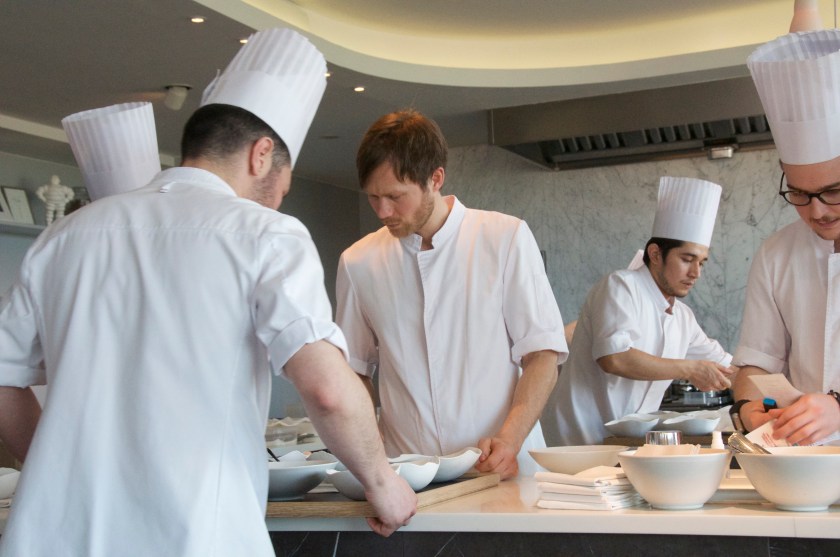
The main dishes followed the appetizers at a leisurely pace. The whole meal took 4 hours, but we never felt rushed or bored in between each course. One thing I noticed was that every chef at some point served us and explained what the dish was, including head chef Rasmus Kofoed. It added just the right amount of personal touch to the haute dining experience. The kitchen also resembled the United Nation of culinary talents so it was interesting to learn where each chef came from as we were being served by them.

The main dishes that followed were:

“Dill Stone” Horseradish & Frozen Juice from Pickled Dill

The fish are presented as “stones” and exploded with flavors when eaten.

This slideshow requires JavaScript.

Salted Hake, Parsley Stems & Finnish Caviar in Buttermilk

This was one of Geranium’s signature dishes and I can see why. The fish was buttery and the caviar added a layer of decadence without overwhelming the delicate hake.

This slideshow requires JavaScript.

Scallop, Fillipa Apple, Scallop Roe & Brown Butter

The scallops were served by Chef Kofed in a theatrical display in front of our table. They were textbook perfection.

This slideshow requires JavaScript.

Crispy Grains, Bread with Old Grains & Gluten Free Bread with Seeds

Oddly this course was disappointing. The various breads were not on par with the dishes that we had had thus far and if anything, the gluten free bread reaffirmed my dislike of it.

This slideshow requires JavaScript.

Pickled Carrots, Smoked Pork Fat & Melted Vesterhavs Cheese

This dish was almost too pretty to eat. The pork fat and cheese flavors were subtle and melded together for a tasty treat.

DSC_3406.jpg

Lightly Salted Turbot, Celeriac & Pickled Pine

This was a good rendition of a fish dish. However, it was overshadowed by all the other creative courses that we’d had thus far.

DSC_3411.jpg

Walnut, Cep Mushroom Soup & Black Truffle

I love truffle and this was a truffle dream. The chef shaved a few slices of black truffle directly into the soup and the smell just enveloped your senses as you tasted the creamy liquid.

This slideshow requires JavaScript.

Grilled Lamb, Ramson & Sheep Cream with Smoked Lumpfish

Our last course was surprisingly small or maybe it seemed diminutive due to the giant plate. However, the dish was the right amount of food to end the savory portion of our meal. Thin slices of tender lamb just melted in our mouths. The lumpfish was the flavor bonus to tie it all together.

DSC_3440.jpg

The assortment of desserts arrived at our table at the same time and they were a work of art. I liked that each dessert was not  sugary and was bite sized.

This slideshow requires JavaScript.

We also ordered the verbena tea and espresso to end our meal. The tea and espresso were good, although the “making” process was gimmicky. For the tea, the server rolled a cart over with a pot of verbena plant and proceeded to snip leaves to brew for the tea. For the espresso, another server rolled out the espresso cart to our table and pressed the coffee by hand. It definitely looked like a workout.

This slideshow requires JavaScript.

Overall, the meal was an unforgettable culinary experience and the extravagant price reflected the Michelin rating. I was grateful that we had had the lunch option as it gave us time to digest our 4 hour meal. Lunch and dinner menus are the same at Geranium. If you have a stopover in Copenhagen, this is one experience I would highly recommend to top your list of activities.

Check out our weekend in Copenhagen by clicking here.

For related articles, visit the TRAVEL page or the World Travel Index.

Author: Chau Hoang

Photos: Gleb Chuvpilo

Hến Xúc Bánh Tráng / Baby Clams with Rice Crackers

Hến xúc bánh tráng or sauteed baby clams served with rice crackers is a classic beer accompaniment dish in Vietnam. It is an easy appetizer to make for snacking anytime of the day. The combination of soft baby clams with crunchy rice cracker is addicting. The medley of clams with various herbs provide for a burst of flavor in your mouth. Enjoy this classic dish today.

Difficulty: Easy / Servings: 4 / Time: 30 minutes

Ingredients

1 package of sesame rice paper

2 and 1/2 cups of baby clams (frozen or from a can)

1/2 teaspoon Knorr chicken bouillon seasoning

1 tablespoon of julienne ginger

1/2 cup of rau ram (Vietnamese Coriander) or use Thai basil if coriander is not available

1 Jalapeno pepper

1/4 red bell pepper

1 yellow onion

3 stalks of scallions

1 tablespoon of minced lemongrass

4 cloves of garlic

1/4 cup of unsalted roasted peanuts

2 tablespoons of vegetable oil

1 and 1/2 teaspoon fish sauce

1/4 teaspoon sugar

1/2 teaspoon ground black pepper

1 tablespoon of water or clam juice

Optional: Fried red onions and Thai basil for toppings


This slideshow requires JavaScript.

Directions:

Mince the 4 cloves of garlic.

Dice half of an onion and cut the other half into thin slices. Mince 1 tablespoon of lemongrass.

IMG_6740

Rough chop 1/2 cup of rau ram (Vetnamese coriander) and dice 3 stalks of scallions.

Cube 1 tablespoon of red bell pepper and slice the remainder of the bell pepper into 7 or 8 long pieces.

Julien ginger, roughly 1 inch lengthwise, for approximately 1 tablespoon.

IMG_6743

Using a food process, lightly pulse 1/4 cup of roasted peanuts. Beware of turning the peanuts into a powder.

IMG_6787

Thoroughly rinse the clams and set aside. Marinate 2 and 1/2 cup of clams with 1/2 teaspoon of chicken bouillon powder, 1/4 teaspoon of ground pepper and 1/4 teaspoon of sugar.

IMG_6748

Heat a large pan on high with 2 tablespoons of vegetable oil. Once the oil is hot, add 1/2 tablespoon of minced lemongrass, 2 tablespoons of diced onion, 1 tablespoon of minced garlic and 1 tablespoon of cubed red bell pepper.

IMG_6755

Once the garlic turns golden, add clams and sauté for 3 minutes. Add 1 and 1/2 teaspoon of fish sauce and all of the onion slices, bell pepper, ginger and scallions. Add 1 tablespoon of water or clam juice. Continue to sauté until the onion becomes translucent, approximately a few minutes. Remove from the heat.

IMG_6777IMG_6781

Add rau ram (Vietnamese coriander) and stir. If you do not have rau ram, just add Thai basil.  Add 1/4 teaspoon of ground black pepper.

IMG_6785

Microwave 1 rice paper at a time for 1 minute on each side until it puffs up. Be careful not to burn the rice paper.

Garnish the clams with thin slices of jalapeno pepper. Top the dish with 1/4 cup of roasted peanuts and some fried onions. Shred some basil leaves and add to the dish for additional flavor.

 fullsizerender 9

fullsizerender 10

img_5848

For more recipes, visit our EAT page or Recipe Index.

Authors: Susan Tran and Chau Hoang

Healthy Chicken Lo Mein

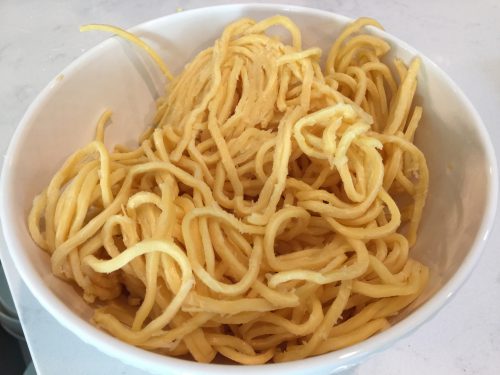
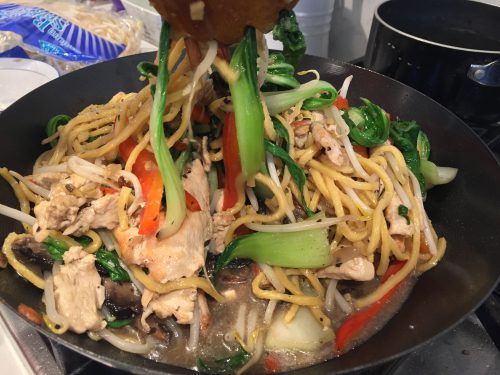
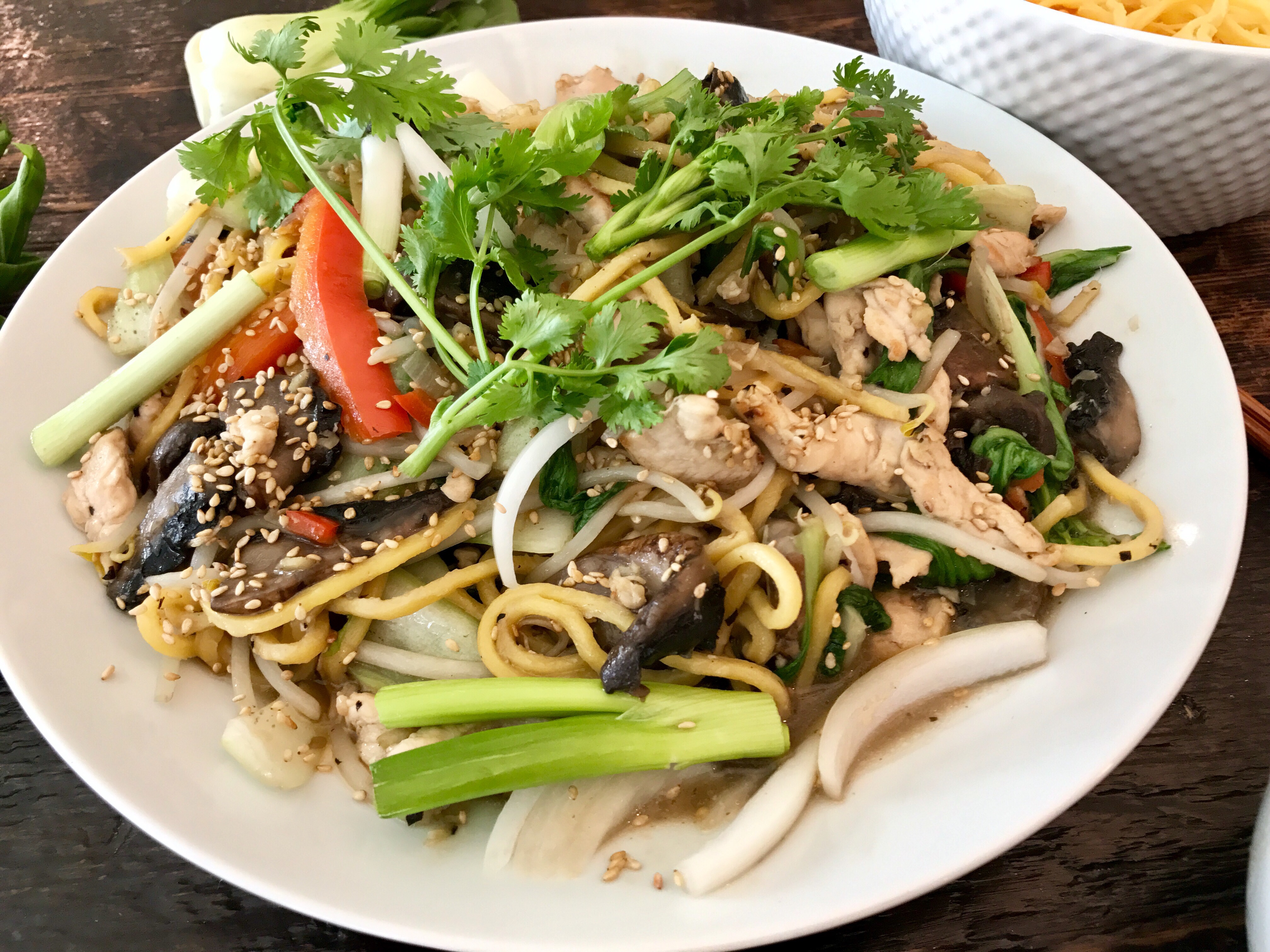
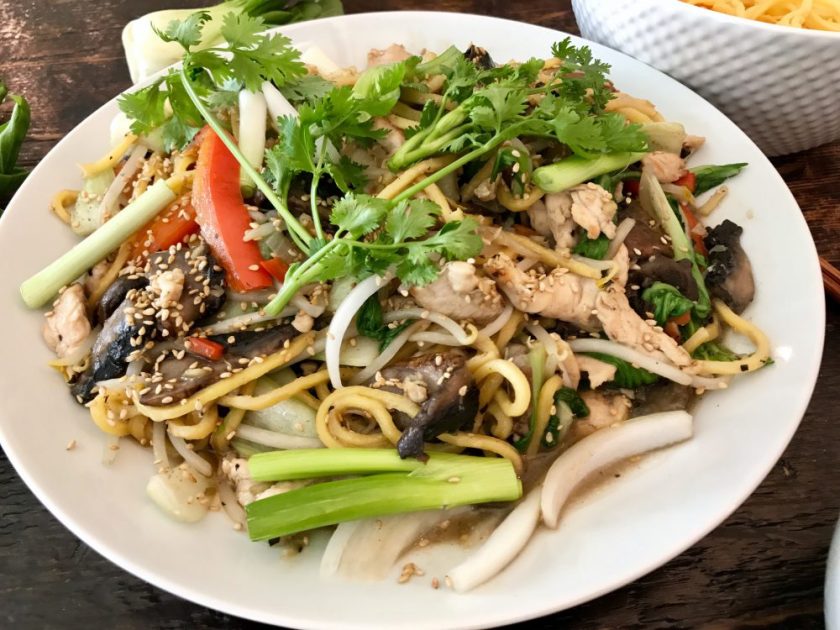
Chicken lo mein has become an ubiquitous American fast food item like hamburger, as every small town USA seems to have a Chinese takeout restaurant. Along with General Tsao Chicken, the American version of chicken lo mein is not something you will find in China. The US version of this inexpensive meal is not healthy to eat…but it is delicious. My mom came up with this healthier version of the dish loaded with fresh white meat chicken and vegetables. This is chicken lo mein that you will not feel guilty about devouring.

Difficulty: Easy / Servings: 4 / Time: 30 minutes

Ingredients:

2 chicken breasts

1/2 package of thick egg noodles

2 Portobello mushroom caps

1 tablespoon of minced garlic

1 yellow onion (2 tablespoons of diced onion and 1/2 of an onion in thick slices)

1 tablespoon of minced ginger

5 stalks of scallions cut into 2 inch segments

1 red bell pepper (1 tablespoon of diced red bell pepper and 1/4 of red bell pepper in julienne slices)

4 bok choi pieces

1 cup of bean sprouts

1 and 1/2 tablespoon of soy sauce or Knorr liquid seasoning

2 tablespoons of oyster sauce

2 tablespoon of cooking wine

1/2 teaspoon of Knorr chicken bouillon powder

1/8 teaspoon of baking soda

1 cup of chicken broth or water

1 tablespoon of sesame oil

Roasted sesame seeds

Fried onions (optional)

Vegetable oil


Directions:

Cut the chicken breast in 1 inch pieces.

Marinate the chicken with 1 and 1/2 tablespoon of soy sauce, 2 tablespoons of cooking wine, 1/8 teaspoon of baking soda and 1/2 teaspoon of chicken bouillon powder for 15 minutes.

In a small bowl, mix 1 cup of chicken broth or water and 2 tablespoons of oyster sauce. Set aside.

IMG_6926

Loosen the noodles.

IMG_6928

Slice the Portobello caps. Cut the ends off of each bok choi and discard the ends. Loosen the leaves.

Heat a wok or a large pan with 3 tablespoons of vegetable oil. Once the oil sizzles, add chicken and press down on the chicken pieces to get a good sear. Flip the chicken over once the chicken is seared on one side. Once the second side turns golden, remove from the heat and set aside.

Add 2 tablespoons of vegetable oil to the wok. Add 1 tablespoon of diced red bell pepper, 1 tablespoon of minced garlic, 2 tablespoons of diced onion and 1 tablespoon of minced ginger.

Once the garlic turns golden, add mushrooms and sauté for a few minutes until they soften.

Next, add bok choi and stir until the leaves wilt. Add 1/2 of a package of noodles, the cooked chicken, 1 cup of beansprouts and the sauce. Mix carefully a few times to incorporate the ingredients without breaking the noodles apart.

IMG_6947

When the sauce have been fully absorbed (i.e. no liquid left), turn off the heat.

Add 1 tablespoon of sesame oil to the chicken lo mein. Top the dish with scallions pieces and onion slices. Sprinkle a handful of sesame seeds and fried onions and serve.

This dish should be eaten within an hour. Since the noodles absorbed all the water based seasoning, they will become mushy if they are not eaten right away.

img_6209

img_6253

For more recipes, visit our EAT page or Recipe Index.

Authors: Susan Tran and Chau Hoang

Review: Tim Ho Wan – NYC Location

Tim Ho Wan (“THW”) is a Hong Kong dim sum destination that was awarded a Michelin star in 2010 for its Mongkok (HK) location and aptly named the “cheapest Michelin star restaurant in the world”. Earlier this year, THW opened its first US location in Manhattan East Village to a lot of buzz and corresponding crazy lines. One Sunday, my group of six ventured to this NY location to see what the hype was all about. My first impression of dim sum at THW was that it was a tamer and more Americanized experience. The restaurant has only 60 seats in a small space so dim sum carts are not a viable option. For me, the fun part is seeing dim sum carts whizzed around a banquet room tempting  diners to flag them down. At THW, the menu has been stripped down to essential dishes.

Getting a table at the restaurant was an experience in itself. We arrived late around 12:00pm assuming that the wait would be 1 to 1.5 hours. The wait turned out to be 3 hours long. We gave our name and a phone number for the restaurant to reach us and went nearby to the Smith for a light brunch. After brunch, we ended up with three people for dim sum. Around 3pm, we received a text indicating that our table was ready and we needed to come back as soon as possible. Once we arrived at THW, it took another 15 minutes be seated. There were still people putting their names on the list and the wait was still three hours. We were told the best way to get a table was to have one sacrificial soul come when they open at 10am and put their name on the waiting list for the whole group to be able to eat around 12.

After we were seated, the waiter came promptly to take our order from the menu that doubled as a placemat. We then proceeded to order almost everything on it. The food came very quickly and we devoured them just as expeditiously. These are the items that we selected for our dim sum.

IMG_3954

Sweet Osmanthus Jelly with Goji Berries and Sweet Pumpkin Cream with Sago

The first thing that came out was sweet osmanthus jelly with Goji berries and sweet pumpkin cream with sago served hot. Interestingly, the desserts came first before the savory dishes. The osmanthus jelly resembled a softer version of Jello and had a light sweet herbal taste. The overall effect was very refreshing. The sweet pumpkin cream was a pudding that was not overly sugary as well.

Baked Bun with BBQ Pork (3 pieces per order)

THW’s signature buns were heavenly as they were flaky on the outside and savory on the inside. The braised pork filling melted in my mouth. The bun crust was sweet, salty and crunchy at the same time. It was so good that we ordered another serving to go. Technically, we were not allowed to order takeout, but were told to order for the table and doggy bag it home. I would come back just for these buns.

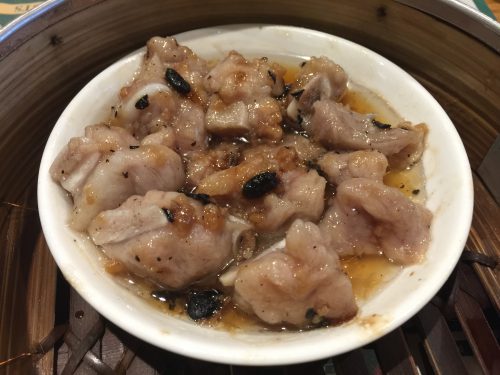
Steam Pork Spare Rib with Black Bean Sauce

THW’s steamed pork spare ribs was a good rendition of the dim sum classic. Succulent morsel of spareribs, with bones, were coated in a fatty savory black bean sauce. It was not the easiest dish or the prettiest dish to eat with a group. However, who can say no to fatty ribs?

IMG_3974

Steamed Pork Dumplings with Shrimp (Siu Mai)

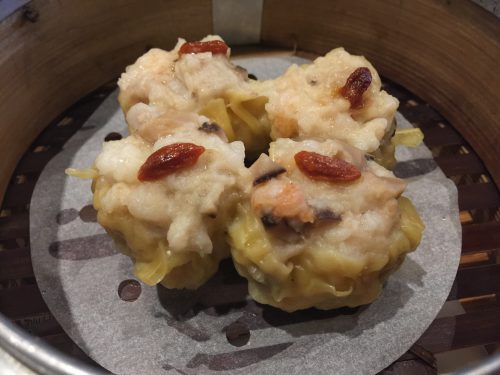
Siu mai is the mascot for any dim sum meal. The shrimp and pork dumpling wrapped in a yellow skin was an easily likeable dish for most dim sum newbies. THW was not cheap about how much filling goes into each dumpling. One thing I liked about these dumplings was that it was not greasy like the Chinatown version. I could have eaten a few more servings of this dish, if not for brunch earlier.

IMG_3978

Steamed Shrimp and Chives Dumplings

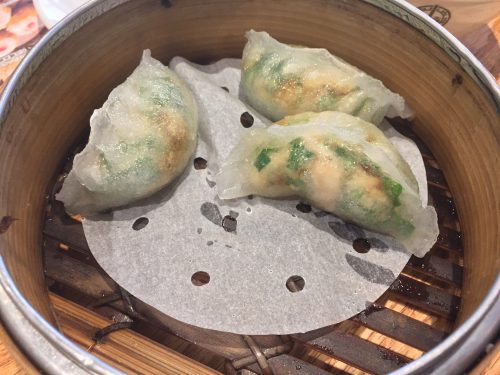
You can differentiate good dim sum parlors from bad ones by the thickness of the dumpling skins. The skin on these steamed shrimp and chives dumplings were very thin, but they were not delicate enough to break apart too easily. The filling peeped through the translucent steamed skin beautifully. The crunchy shrimp and light onion taste makes these dumplings so satisfactory.

IMG_3970

Steamed Shrimp Dumplings

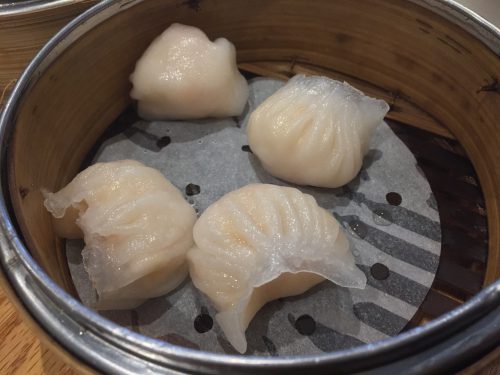
Steamed shrimp dumplings were very similar to the shrimp and chive version and just as good.

IMG_3969

Sticky Rice in Lotus Leaf

A large sticky rice ball is filled with braised pork at the center and steamed in a lotus leaf. The sticky rice was moist and the braised pork adds the right amount of flavor and textural contrast. This is another classic dim sum dish that THW does well.

Braised Chicken Feet with Abalone Sauce and Peanut

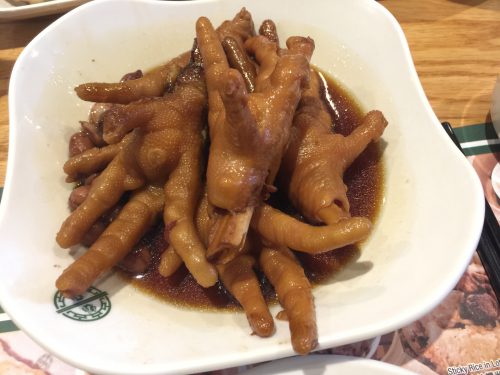
Chicken feet always scare people because, well, it’s chicken feet. I grew up eating chicken feet at dim sum restaurants and was stoked that THW had this on their menu. The chicken feet was one of the better rendition that I had as the abalone sauce was really tasty. The skin melted off the bone and the savory abalone sauce coats every piece of skin. This was so delicious and was not greasy at all.

IMG_3963

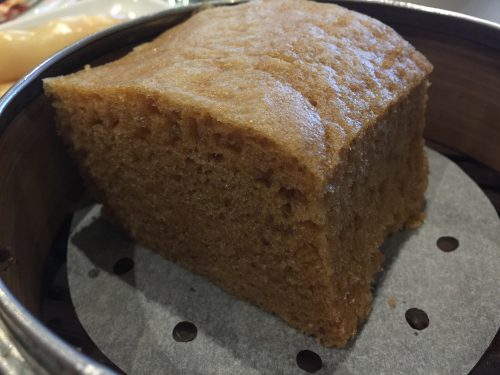
Steamed Egg Cake

The steamed egg cake resembled a sponge cake but with a heavier egg taste. The texture is very light, fluffy and not overly sweet like American desserts. This is a perfect cake to go with tea.

IMG_3976

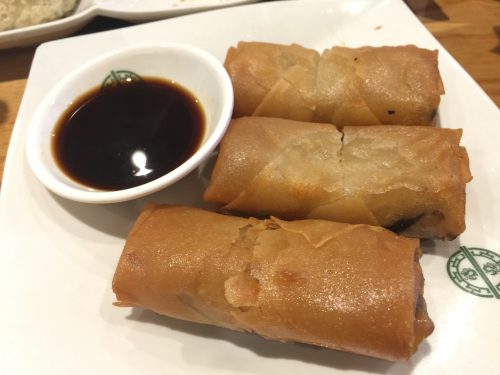
Deep Fried Vegetable Spring Roll

This was a simple vegetable spring roll dish that was prepared well. There wasn’t anything particularly special about this dish. This was an addition to the THW HK menu for the American location.

IMG_3971

Steamed Rice Rolls Stuffed with Shrimps

This is the Chinese version of lasagna. A thin layer of rice flour batter is steamed until it solidifies. Next, shrimp are added to the rolls and the rice rolls are drenched with soy sauce. This is another classic dim sum dish and is one of my favorite dish.

IMG_3972

Overall, the US offshoot for THW was better than many of the Manhattan dim sum parlors that I have tried. It was obvious that the quality of the ingredients were much higher than their Chinatown competition and the slightly higher prices reflected that improvement. Prices were approximately $1-$2 more per dish than Chinatown. Even though I enjoyed my meal at THW, I would not want to wait for 3 hours again to eat here. This dim sum restaurant is worth at most a 1 hour wait for a repeat. For first time diners, this may be worth the long lines to try it once.

Author: Chau Hoang

Featured Photo: Tim Ho Wan

Bánh Bèo / Steamed Rice Cakes with Shrimp

Bánh bèo is a variety of steamed rice cakes or mini pancakes that originated from Hue, Vietnam. Tiny ceramic plates containing a small amount of a simple rice flour batter are steamed and topped with various savory ingredients such as dried shrimp, mung bean, fried pork, croutons, and scallion oil and then drenched in a salty sweet fish sauce. It is the quintessential group meal as everyone gets a chance to customize their rice cakes with various toppings. It’s not uncommon to see stacks of empty plates piled high on the table. This meal can feed a large crowd with few inexpensive ingredients.  The best part is the conversations with friends and family while waiting for the rice cakes to steam.

Difficulty: Easy / Servings: 6 / Time: 30 minutes to prepare, 8 minutes to steam each batch of rice cakes

Ingredients:

20 jumbo shrimps

4 cups of water

2 and 1/2 cup of Bánh Bèo flour mix (approximately 1 package available online or at any Asian supermarket)

3 tablespoons of tapioca starch

3 cloves of minced garlic

1/2 cups of diced scallions

1/2 cup of vegetable oil

1 cup of pre-made fried red onions or you can fry some yellow onion slices until they turn golden brown

1/2 cup of sugar

1/2 teaspoon salt

1/2 cup of fish sauce

2 cups of coconut soda

1/2 of a Thai red chili diced

1 package of Chicarone

Optional: 1/2 cup of Vietnamese pickled carrots and daikon (This is typically seen in south of Vietnam as a topping.) Recipe link here.

Equipment:

A flat bottom steamer

At least 20 small plates approximately 4 inches in diameter or you can use muffing tins or mini tart molds.

This slideshow requires JavaScript.

Directions:

In a large bowl, mix 4 cups of water, 2 and 1/2 cup of bánh bèo flour mix, 3 tablespoons of tapioca starch and 1/4 teaspoon of salt.

Bring a small pot of water to a boil with 1/4 teaspoon of salt. You will only need enough water to submerge the shrimp. Once the water comes to a rolling boil, add the shrimp and let them cook for approximately 2-3 minutes until they turn light pink.

Drain, peel and devien the shrimp and minced them in a food processor. This should yield approximately 2 cups of minced shrimp. Optional: To make the shrimp look more vibrant, add 2 drops of yellow food color and 1 drop of red food color and mix well.

This slideshow requires JavaScript.

Heat a pan on medium heat. Add minced shrimp and continue to stir so it does not burn. The shrimp will dry out and becomes fluffy after 3 to 5 minutes.

Make scallion oil by microwaving 1/2 cups of diced scallion and 1/2 cup of vegetable oil for 40 seconds.

IMG_6864

after: scallion oil

Make the sauce by combining 2 cups of coconut soda with 3 cloves of minced garlic, 1/2 of a red Thai chili diced, 1/2 cup of sugar and 1/2 cup of fish sauce.

Steam the rice cakes:

Prepare a large flat bottom steamer. Once the steam starts coming through the bottom layer, add the mini dishes. Brush the dish with some vegetable oil. Pour the batter so that it hits 3/4 up the side of the dish and close the lid. Steam for 4 minutes and open the lid to release the steam. Close the lid and steam for another 4 minutes. This will give the pancakes their trademark dimples. Remove from the steamer and allow to cool for a minute before handling the dish.

To Serve:

Top each dish with a spoonful of dry shrimp, scallion oil, fried onions, chicarone, pickled daikon and carrots and fish sauce. Eat it right off the plate. Bánh bèo is best eaten right out of the steamer as the rice cake hardens the longer it is left on the table.

img_6005img_5880img_6082
For more recipes, visit our EAT page or Recipe Index.

Authors: Susan Tran and Chau Hoang